



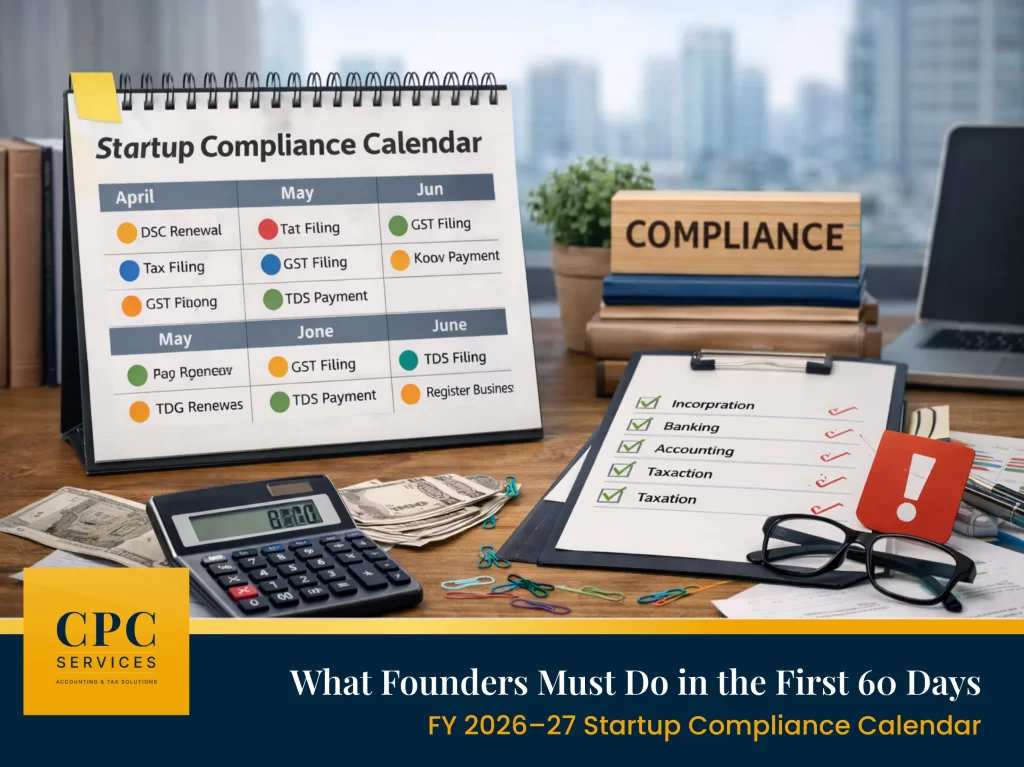
A new financial year brings fresh energy — hiring plans, product roadmaps, fundraising conversations. But for founders, startup compliance is the one area that quietly gets pushed to the back burner. This is exactly where problems begin and why addressing startup compliance in April and May is critical to your company’s health for the rest of FY 2026–27.
And that is exactly where problems begin.
The first 60 days of FY 2026–27 (April and May) are not just administrative months. They are the window in which your startup either builds a clean, investor-ready compliance foundation or carries forward problems that show up at the worst possible time: during a funding round, a government audit, or a regulatory notice.
This blog covers exactly what your startup needs to handle in these 60 days, ROC filings for startups, MCA compliance,GST compliance, and tax responsibilities, TDS and payroll compliance, and bookkeeping alignment so you can stay legally protected while staying focused on growth.
Quick Tip
Schedule a startup compliance review in the first two weeks of April.
Catching gaps early costs you a few hours.
Catching them in August or September, during filing season or due diligence can cost significantly more.
Why Startup Compliance in the First 60 Days Sets the Tone
Founders often assume that compliance deadlines are months away. Technically true. Practically dangerous. April and May are when your startup should build the groundwork that makes every filing for the rest of FY 2026–27 accurate and on time. Miss this window and errors compound fast. Wrong opening balances, missed TDS entries, and unreconciled GST credits pile up. By Q3, you are scrambling to fix past months or filing with incorrect data.
Furthermore, here is what typically needs to happen during this period:
- Close and finalize FY 2025–26 financial records
- Reconcile GST returns and input tax credit claims
- Review TDS deductions and deposit duties
- Update statutory registers and company documentation
- Align accounting systems for the new financial year
- Set up a startup compliance calendar for FY 2026–27
Important Note
Delays in April and May often create data gaps that affect GST returns, income tax filings, and investor due diligence later in the year. These gaps rarely stay small, they grow as the months pass.
Key Startup Compliance Areas to Address in the First 60 Days
1. ROC Filings — A Critical Startup Compliance Obligation
If your startup is registered as a Private Limited Company or LLP, your duties under the Ministry of Corporate Affairs do not pause at the start of the financial year, they reset.
As part of your startup compliance routine, early in FY 2026–27, startups should ensure:
- Statutory registers are updated (directors, shareholders, share allotments)
- Board meeting minutes from FY 2025–26 are properly recorded
- Director and shareholder information is accurate on the MCA portal
- Documentation for upcoming annual ROC filings is being prepared
Investors and lenders routinely check MCA records before funding discussions. Clean, updated records signal that your startup is seriously managed, not just well-pitched.
Reminder
Directors should verify their company’s MCA portal records at the start of every financial year.
Incorrect or outdated filings can delay fundraising and trigger regulatory queries.
2. GST: Key Startup Compliance Action for April–May
The start of a new financial year is the right time to review how your GST filings closed in FY 2025–26 and set up clean processes for FY 2026–27.
Priority startup compliance actions for GST in April–May:
- Reconcile GSTR-1 and GSTR-3B filings from FY 2025–26
- Verify and correct input tax credit claims on the GST portal
- Update billing systems and GST configurations if there are any rate or category changes
- Review compliance for interstate transactions or e-commerce operations
In addition, startups in SaaS, e-commerce, or multi-state operations face additional GST complexity. Errors here tend to attract GST notices, which are time-consuming and disruptive to fix.
3. TDS and Payroll — Ongoing Startup Compliance Duties
If your startup has employees or makes payments to vendors and contractors, TDS duties are continuous throughout the year. Therefore, the start of FY 2026–27 is the time to ensure your payroll and TDS systems are correctly set up.
- Confirm TDS deductions on employee salaries are correctly calculated for the new salary structures
- Issue Form 16 to all employees for FY 2025–26
- File Q4 TDS returns from the previous year if pending
- Ensure payroll records are updated for any new hires or salary revisions
Quick Tip
If you hired employees mid-year in FY 2025–26, verify that TDS was correctly deducted across all months. Partial-year errors are among the most common causes of TDS notices.
4. Accounting and Bookkeeping Alignment
Starting FY 2026–27 with accurate opening balances is non-negotiable. Many startups especially first-time founders carry forward unreconciled entries from the previous year, which creates cascading errors in every financial report going forward.
Founders should verify that:
- Opening balances are correctly entered and reconciled
- Revenue and expense categories are properly structured
- Bank statements from March 2025 are fully reconciled
- Any pending invoices or vendor payments from FY 2025–26 are closed or properly carried forward
Accurate bookkeeping is also what gives founders clarity on cash flow and burn, essential information whether you are bootstrapped or in active fundraising discussions.
5. Updating Statutory Records
Companies Act requirements mandate that startups maintain and update several statutory records throughout the year. However, most founders only think about these before audits by which point reconstruction is costly and time-consuming. The beginning of the financial year is the best time to audit these proactively.
- Register of Directors and Key Managerial Personnel
- Register of Members (shareholders)
- Minutes of Board and General Meetings
- Share allotment and transfer documentation
- Any ESOP or convertible instrument records
CPC Insight
Startups that maintain statutory records consistently throughout the year rather than reconstructing them before audits significantly reduce the time and cost of annual ROC filings and investor due diligence.
Startup Compliance Checklist: First 60 Days
| Period | Compliance Action |
| April | Finalise and close FY 2025–26 financial records |
| April | Reconcile GST returns and verify input tax credit |
| April | Deposit any pending TDS and verify Q4 returns |
| April | Issue Form 16 to employees for FY 2025–26 |
| April – May | Update statutory registers and company documentation |
| April – May | Reconcile bank accounts and set up correct opening balances |
| April – May | Review payroll structure and confirm TDS rates for new year |
| May | Create startup compliance calendar for FY 2026–27 deadlines |
| May | Verify MCA portal records and director information |
| May | Conduct internal startup compliance review and identify any gaps |
Common Compliance Mistakes Startups Make at the Start of the Year
Most startup compliance problems are not the result of ignorance, they are the result of delay. Founders know compliance matters; they just assume there is time to deal with it later.
The most common early-year mistakes include:
- Not closing the previous year’s books properly – leading to incorrect opening balances and cascading accounting errors
- Skipping GST reconciliation – unreconciled ITC claims invite scrutiny and notices
- Delaying Form 16 issuance – this creates issues for employees filing their personal ITR via the Income Tax portal
- Ignoring statutory register updates – especially after funding rounds, ESOPs, or director changes
- Mixing personal and business expenses – a red flag in audits and investor due diligence
- Having no compliance calendar – reactive compliance is always more expensive than planned compliance
Common Mistake
Many founders postpone statutory register updates after a funding round or director change, assuming it can be “sorted later.” Consequently, these gaps are exactly what surface during investor due diligence — often at the worst possible moment.
Why Startup Compliance Is a Growth Lever, Not Just a Legal Requirement
Founders who treat startup compliance as a checkbox exercise miss a larger point: clean compliance is what makes everything else easier, fundraising, banking, hiring, and scaling.
Investor Confidence
Investors review MCA records, GST filings, and financial statements before funding. Gaps here slow down or kill deals.
Financial Transparency
Accurate, up-to-date records give founders real clarity on cash flow, burn rate, and financial health.
Penalty Prevention
Timely filings avoid government fines, interest charges, and notices that consume management bandwidth.
Operational Discipline
Structured compliance processes reflect well-run operations which matters when hiring senior talent or applying for credit.
Key Takeaway
For startups in Faridabad, Delhi NCR, or anywhere across India, regulatory startup compliance is not a burden that competes with growth, it is the foundation that makes sustainable growth possible.
Compliance Pressure? Let’s Fix It.
Whether you missed a filing, received a notice, or simply want an expert to review your startup compliance status — CPC Services is here. Since 1987, we have helped businesses stay compliant, penalty-free, and investor-ready.
At CPC Services, we work with startups across Faridabad and Delhi NCR from first-time founders registering their Private Limited Company to growth-stage businesses managing multi-state GST compliance. The founders who build strong startup compliance habits early rarely face the regulatory disruptions that slow down those who do not.

