


C P C S E R V I C E S

Loading

CPC Services Pvt. Ltd.

PAN & TAN Forms 2026 Update: Avoid Costly Mistakes Now

PAN & TAN Forms 2026 Update: Avoid Costly Mistakes Now

Search
Top Reads
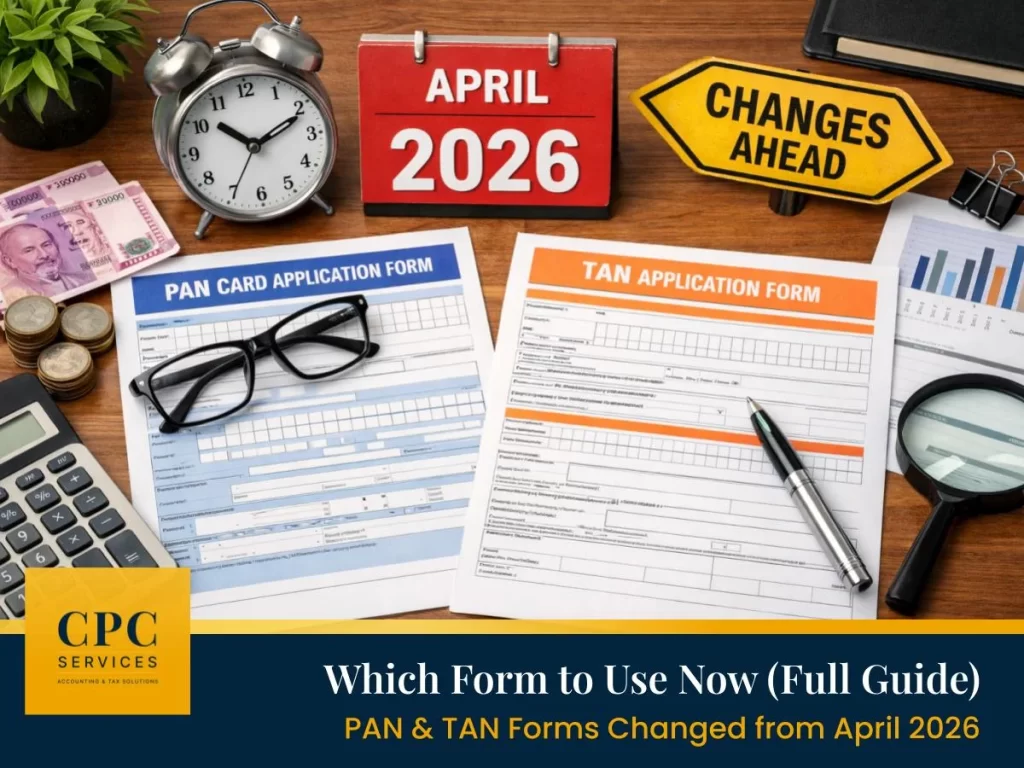
New PAN and TAN application forms 2026 showing updated structure and categories for individuals and businesses

Applying for a PAN or TAN is a standard compliance requirement for individuals, businesses, and professionals. But with the 2026 updates to application forms, even small mistakes can lead to rejection, delays, or costly rework—making it crucial to stay updated before you apply. While the application process remains largely similar, the structure and classification have changed significantly—making it important to use the correct form from the start.

Effective from 1 April 2026
The new PAN and TAN application forms will be applicable. Old forms will no longer be accepted, and all new applications must be submitted using the updated formats.

Click Here to Read Official FAQ on New PAN and TAN Forms

PAN Form 2026 Update: Key Changes You Must Know

  • Old PAN forms 49A and 49AA are replaced
  • New PAN forms 93, 94, 95 and 96 are introduced

Classification of PAN Application:

  • Residential Status (Resident / Non-Resident)
  • Applicant Type (Individual / Non-Individual)

Classification of TAN Application:

  • Government entities
  • Non-Government entities

PAN & TAN Forms 2026: Old vs New Comparison

Old FormPurposeNew Form
Form 49APAN – Indian residentsForm 93 / 94
Form 49AAPAN – Foreign applicantsForm 95 / 96
Form 49BTAN applicationForm No 134 & 135 for Govt Entities & Other than Govt entities

PAN Application Form 2026: New Format and Structure

The new PAN system introduces four clearly defined forms:

1. Resident Individual

(Professional / Salaried / Freelancers)

2. Resident Non-Individual

(Companies / Partnerships / LLPs / Trusts)

3. Non-Resident Individual

(NRIs / Foreign Individuals with Indian Tax Obligations)

4. Non-Resident Non-Individuals

(Foreign / Overseas / International)

TAN Application Forms 2026: New Format and Structure

The TAN application process has been simplified into two categories: Government entities and Non-Government entities, each with its own dedicated form. This clear classification ensures better organization for departments, corporates, and businesses responsible for deducting TDS.

CPC Insight
Incorrect PAN or TAN form selection can delay multiple downstream processes such as GST registration, banking setup, and compliance filings.

Why This Change Matters For Businesses & Professionals

1. Better Classification

The new structure removes confusion by clearly separating:

  • Individuals vs entities
  • Residents vs non-residents

2. Reduced Errors in Applications

  • Earlier, incorrect form selection was a common issue.
  • Now, structured classification helps minimize mistakes.

3. Faster Processing

With clearer data and correct categorization:

  • Applications are expected to be processed more efficiently

4. Important for Business Compliance

For businesses and professionals:

  • Incorrect PAN application can delay GST registration, banking, and compliance filings
  • Wrong TAN selection can impact TDS compliance

Direct tax compliance services play a critical role in ensuring correct PAN and TAN application. Even small mistakes can affect multiple downstream processes

Common Mistake 
Applicants often select forms based on familiarity with old formats instead of verifying updated classification criteria.

What Happens If You Use Old PAN and TAN Forms?

Using outdated PAN or TAN forms can result in application rejection, processing delays, or the need to reapply from scratch. Such issues may cause unnecessary delays in business registrations, financial transactions, and compliance deadlines. Leveraging proper business compliance support and submitting the updated forms ensures smooth processing and timely approvals.

Our Takeaway

The shift to the new PAN and TAN application forms is straightforward but crucial for businesses and professionals. Using the correct form based on your category, confirming the latest format, and clarifying residential status and entity type are key steps. Accuracy at the first stage of compliance helps save time, reduce costs, and prevent unnecessary rework later.

Best Practice
Before starting any PAN or TAN application, it is important to verify the applicant type, residential status, and ensure you are using the latest 2026 form version.

Need Help Choosing the Right PAN or TAN Form?

Many individuals and businesses still face confusion when selecting the correct PAN or TAN form, especially when handling multiple registrations or compliance requirements.

At CPC Services Pvt. Ltd, we help clients identify the appropriate application category, avoid rejection due to incorrect form selection, and ensure smooth compliance from day one.
If you’re unsure which form to use, it’s always better to seek expert guidance before applying rather than redoing the process later. Get professional assistance to make your PAN and TAN application accurate and hassle-free.

Need Help With GST & Taxes?

We handle your GST and taxes efficiently, ensuring compliance and optimized savings.

Frequently Asked Questions

PAN (Permanent Account Number) is a unique identification number issued by the Income Tax Department to taxpayers. It is mandatory for filing income tax returns and for various financial transactions such as banking, investments, and high-value transactions. Read More

Any individual or entity required to file income tax returns or engage in specified financial transactions must apply for PAN. This includes salaried individuals, businesses, professionals, and foreign entities dealing in India. Read More

PAN is used to identify taxpayers, while TAN (Tax Deduction and Collection Account Number) is required for entities responsible for deducting or collecting tax at source (TDS/TCS). PAN cannot be used in place of TAN where TAN is mandatory.

Under the Income-tax Rules, 2026, PAN applications must be filed using:

  • Form 93 → Resident Individuals
  • Form 94 → Resident Non-Individuals
  • Form 95 → Non-Resident Individuals
  • Form 96 → Non-Resident Non-Individuals

Discover More : Click Here

If a PAN application is rejected due to incorrect or incomplete information, it is treated as invalid. In such cases, a fresh application must be submitted with correct details and supporting documents. Read More

Frequently Asked Questions

PAN (Permanent Account Number) is a unique identification number issued by the Income Tax Department to taxpayers. It is mandatory for filing income tax returns and for various financial transactions such as banking, investments, and high-value transactions. Read More

Any individual or entity required to file income tax returns or engage in specified financial transactions must apply for PAN. This includes salaried individuals, businesses, professionals, and foreign entities dealing in India. Read More

PAN is used to identify taxpayers, while TAN (Tax Deduction and Collection Account Number) is required for entities responsible for deducting or collecting tax at source (TDS/TCS). PAN cannot be used in place of TAN where TAN is mandatory.

Under the Income-tax Rules, 2026, PAN applications must be filed using:

  • Form 93 → Resident Individuals
  • Form 94 → Resident Non-Individuals
  • Form 95 → Non-Resident Individuals
  • Form 96 → Non-Resident Non-Individuals

Discover More : Click Here

If a PAN application is rejected due to incorrect or incomplete information, it is treated as invalid. In such cases, a fresh application must be submitted with correct details and supporting documents. Read More

Frequently Asked Questions

PAN (Permanent Account Number) is a unique identification number issued by the Income Tax Department to taxpayers. It is mandatory for filing income tax returns and for various financial transactions such as banking, investments, and high-value transactions. Read More

Any individual or entity required to file income tax returns or engage in specified financial transactions must apply for PAN. This includes salaried individuals, businesses, professionals, and foreign entities dealing in India. Read More

PAN is used to identify taxpayers, while TAN (Tax Deduction and Collection Account Number) is required for entities responsible for deducting or collecting tax at source (TDS/TCS). PAN cannot be used in place of TAN where TAN is mandatory.

Under the Income-tax Rules, 2026, PAN applications must be filed using:

  • Form 93 → Resident Individuals
  • Form 94 → Resident Non-Individuals
  • Form 95 → Non-Resident Individuals
  • Form 96 → Non-Resident Non-Individuals

Discover More : Click Here

If a PAN application is rejected due to incorrect or incomplete information, it is treated as invalid. In such cases, a fresh application must be submitted with correct details and supporting documents. Read More

Search
Top Reads

Frequently Asked Questions

PAN (Permanent Account Number) is a unique identification number issued by the Income Tax Department to taxpayers. It is mandatory for filing income tax returns and for various financial transactions such as banking, investments, and high-value transactions. Read More

Any individual or entity required to file income tax returns or engage in specified financial transactions must apply for PAN. This includes salaried individuals, businesses, professionals, and foreign entities dealing in India. Read More

PAN is used to identify taxpayers, while TAN (Tax Deduction and Collection Account Number) is required for entities responsible for deducting or collecting tax at source (TDS/TCS). PAN cannot be used in place of TAN where TAN is mandatory.

Under the Income-tax Rules, 2026, PAN applications must be filed using:

  • Form 93 → Resident Individuals
  • Form 94 → Resident Non-Individuals
  • Form 95 → Non-Resident Individuals
  • Form 96 → Non-Resident Non-Individuals

Discover More : Click Here

If a PAN application is rejected due to incorrect or incomplete information, it is treated as invalid. In such cases, a fresh application must be submitted with correct details and supporting documents. Read More

Related Blogs