



C P C S E R V I C E S

Loading

CPC Services Pvt. Ltd.

The Best 80C Investment Options: ELSS, PPF and NPS

The Best 80C Investment Options: ELSS, PPF and NPS

Search
Top Reads
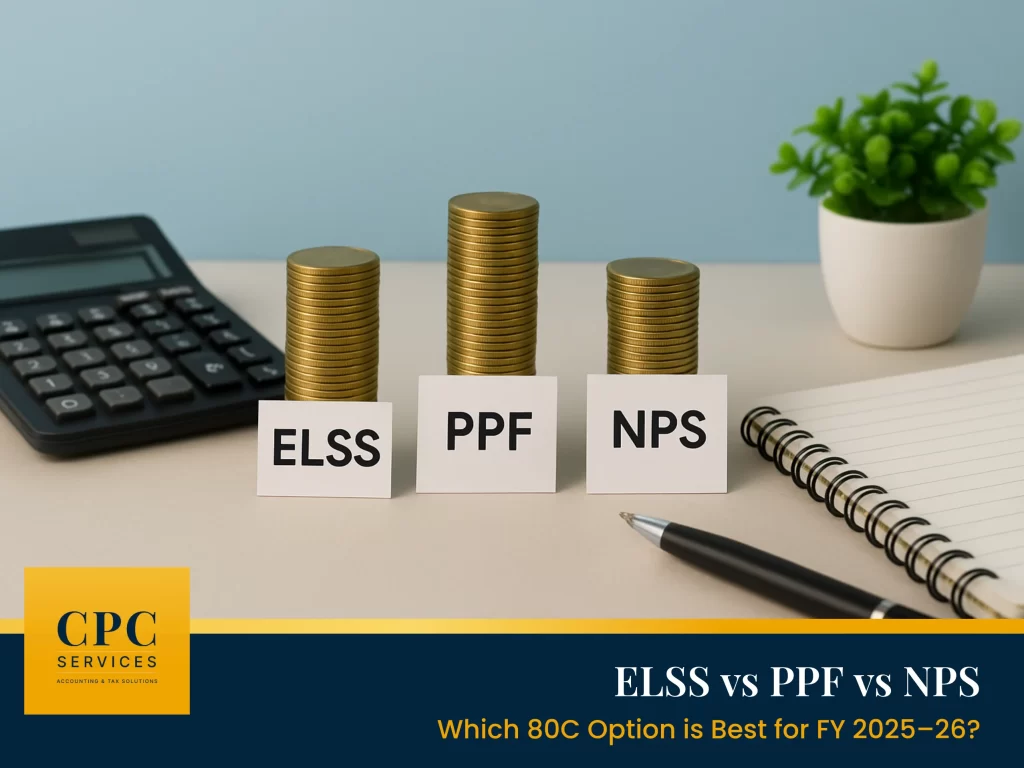
Infographic comparing ELSS, PPF, and NPS for 80C investments FY 2025–26

Choosing the right tax-saving investment under Section 80C is no longer just about saving tax — it’s about not losing wealth over time. With the right tax planning and wealth management strategy, investors can significantly improve long-term outcomes.

Many taxpayers unknowingly lock their money into low-growth options or miss higher-return opportunities simply because they don’t compare their choices properly. The result? Lower long-term returns, inefficient direct tax planning, and missed financial goals.

COMMON MISTAKE
Choosing tax-saving options solely for safety
or familiarity without evaluating long-term returns.

Among all tax-saving schemes in India, ELSS, PPF, and NPS remain the most widely used and searched options. Each serves a different purpose — wealth creation, capital safety, or retirement planning — areas where professional financial advisory services play a critical role.

This expert comparison for FY 2025–26 will help salaried individuals, professionals, and high-income earners decide which 80C option suits them best — or how to combine them smartly with guidance from a trusted financial & tax consultancy.

ADVISORY
Always align your 80C investments with your broader financial plan,
not just yearly tax-saving needs.

Section 80C Explained (Simple & Clear)

Section 80C of the Income Tax Act allows individuals to claim a deduction of up to ₹1.5 lakh from taxable income by investing in eligible instruments,  not only providing an opportunity to save tax (under the old regime but also it helped you to create wealth for rainy seasons or old aged by investing in right mix) subject to proper tax compliance and planning.

IMPORTANT NOTE
Section 80C benefits are available only under the old tax regime.

However, all 80C investments are not equal. They differ significantly in:

  • Risk exposure
  • Lock-in period
  • Return potential
  • Liquidity
  • Financial objective

The three most compared options are:

  • ELSS (Equity Linked Savings Scheme) – Growth-focused
  • PPF (Public Provident Fund) – Safety-focused
  • NPS (National Pension System) – Retirement-focused

ELSS vs PPF vs NPS: Detailed Comparison

FeatureELSSPPFNPS
Investment TypeEquity mutual fundGovernment-backed savingsPension scheme
Risk LevelModerate to HighVery LowModerate
Expected ReturnsMarket-linked (higher potential)Fixed & stableMarket-linked
Lock-in Period3 years15 yearsTill retirement
Tax BenefitSection 80CSection 80C80C + extra ₹50,000 (80CCD(1B))
Best ForWealth creationCapital protectionRetirement planning

REMINDER
Returns are indicative and depend on market conditions and government-declared rates.

ELSS: Best 80C Option for Long-Term Wealth Creation

ELSS funds invest primarily in equity markets and are designed for investors who want higher long-term returns with tax benefits, often forming the core of a professional investment and wealth strategy.

Why ELSS Is Popular Among Professionals

  • Shortest lock-in period under Section 80C (3 years)
  • Potential to beat inflation over the long term
  • Suitable for salaried individuals, business owners, and freelancers

Important Considerations

  • Short-term market volatility is possible
  • Best results when held beyond the lock-in period

ELSS works best for investors in the early or middle stage of their career who can tolerate market fluctuations and seek long-term growth through expert advisory services.

PPF: Ideal for Safety-Oriented Investors

PPF is a government-backed scheme preferred by investors who value capital safety and predictable returns, making it suitable for conservative financial planning.

Why Conservative Investors Choose PPF

  • Very low risk
  • Interest and maturity amount are tax-free
  • Encourages disciplined long-term savings

Limitations of PPF

  • Long lock-in period of 15 years
  • Returns may struggle to beat inflation over long periods

IMPORTANT NOTE
PPF interest rates are revised periodically by the government.

PPF suits risk-averse investors and those nearing retirement who prioritise stability over growth.

NPS: A Powerful Tool for Retirement & Extra Tax- Saving

NPS is designed specifically for building a retirement corpus while offering additional tax benefits beyond Section 80C, and is often recommended as part of structured long-term tax planning.

Key Benefits of NPS

  • Extra tax deduction of ₹50,000 under Section 80CCD(1B)
  • Long-term, disciplined retirement planning
  • Suitable for salaried and self-employed individuals

Things to Keep in Mind

  • Limited liquidity before retirement
  • A portion of the corpus must be used to purchase an annuity

NPS works best for long-term planners who want tax efficiency along with retirement security.

Which Is the Best 80C Option for FY 2025–26?

There is no single best option that fits everyone. The right choice depends on:

  • Age
  • Income level
  • Risk appetite
  • Financial goals

General Guidance

  • Young earners may benefit more from ELSS
  • Conservative savers often prefer PPF
  • Long-term planners should include NPS

In practice, a combination strategy often delivers better results than relying on just one option, especially when structured with professional tax and advisory support.

Smart Tax-Saving Strategy (Expert Approach)

Instead of putting all ₹1.5 lakh into a single scheme, investors can:

  • Use ELSS for growth
  • Allocate PPF for stability
  • Add NPS for retirement and extra tax deduction

This balanced approach helps:

  • Manage risk effectively
  • Improve post-tax returns
  • Align investments with multiple financial goals

Such structured planning is commonly adopted by high-income individuals and businesses across industries we serve.

Who Should Invest in What?
(Quick Checklist)

Choose ELSS if you:

  • Are comfortable with market ups and downs
  • Want higher long-term returns
  • Are in the early or middle stage of your career

Choose PPF if you:

  • Prefer safety and predictable returns
  • Want a disciplined long-term savings option
  • Are close to retirement or risk-averse

Choose NPS if you:

  • Want to build a retirement corpus
  • Need extra tax deduction beyond Section 80C
  • Have a long investment horizon

QUICK TIP
Review your investment mix annually to stay aligned with changing goals.

When comparing ELSS vs PPF vs NPS, the right choice depends on your income, risk appetite, and financial stage. A well-planned mix of these tax-saving schemes in India, supported by professional wealth and tax advisory, can help achieve better returns, improved tax efficiency, and long-term financial security.

Need Personalised Tax & Investment Guidance?

High-income professionals and business owners often lose significant tax-saving opportunities due to poor investment structuring.

Our Wealth Management andTax Planning Services under Section 80C help you design a customised investment strategy aligned with your income, goals, and risk profile.

📞 Contact our advisors for personalised wealth and tax planning support or explore our pricing plans.


Need Help With GST & Taxes?

We handle your GST and taxes efficiently, ensuring compliance and optimized savings.

Frequently Asked Questions

The best tax-saving investment under Section 80C for FY 2025–26 depends on your financial goal. ELSS is suitable for investors seeking higher long-term returns, PPF works best for capital safety, while NPS is ideal for retirement-focused tax planning. Many professionals use a combination of these options as part of a structured tax planning strategy under our Direct Tax Services to optimise returns and tax-savings.

For salaried employees and professionals with a long investment horizon, ELSS is often better than PPF due to its higher return potential and shorter lock-in period. However, PPF offers guaranteed safety and stable returns. Choosing between ELSS and PPF should be based on income level, risk appetite, and overall Wealth Management planning.

Yes, high-income earners can invest in ELSS, PPF, and NPS simultaneously to balance growth, safety, and retirement planning. ELSS helps with wealth creation, PPF adds stability, and NPS provides an additional ₹50,000 tax deduction under Section 80CCD(1B). This approach is commonly recommended through professional Advisory Services for high-income professionals and business owners.

For retirement planning in India, NPS is considered one of the most tax-efficient 80C options, especially for long-term investors. It not only helps build a retirement corpus but also offers additional tax benefits beyond Section 80C. Many investors combine NPS with other retirement-focused solutions under professional Advisory Services.

Professionals should avoid selecting 80C investments purely for tax-saving. Instead, they should align their choice with financial goals, risk profile, and time horizon. A structured mix of ELSS, PPF, and NPS — guided by expert Financial Advisory and Tax Planning services — helps prevent low returns and improves long-term wealth outcomes.

Frequently Asked Questions

The best tax-saving investment under Section 80C for FY 2025–26 depends on your financial goal. ELSS is suitable for investors seeking higher long-term returns, PPF works best for capital safety, while NPS is ideal for retirement-focused tax planning. Many professionals use a combination of these options as part of a structured tax planning strategy under our Direct Tax Services to optimise returns and tax-savings.

For salaried employees and professionals with a long investment horizon, ELSS is often better than PPF due to its higher return potential and shorter lock-in period. However, PPF offers guaranteed safety and stable returns. Choosing between ELSS and PPF should be based on income level, risk appetite, and overall Wealth Management planning.

Yes, high-income earners can invest in ELSS, PPF, and NPS simultaneously to balance growth, safety, and retirement planning. ELSS helps with wealth creation, PPF adds stability, and NPS provides an additional ₹50,000 tax deduction under Section 80CCD(1B). This approach is commonly recommended through professional Advisory Services for high-income professionals and business owners.

For retirement planning in India, NPS is considered one of the most tax-efficient 80C options, especially for long-term investors. It not only helps build a retirement corpus but also offers additional tax benefits beyond Section 80C. Many investors combine NPS with other retirement-focused solutions under professional Advisory Services.

Professionals should avoid selecting 80C investments purely for tax-saving. Instead, they should align their choice with financial goals, risk profile, and time horizon. A structured mix of ELSS, PPF, and NPS — guided by expert Financial Advisory and Tax Planning services — helps prevent low returns and improves long-term wealth outcomes.

Frequently Asked Questions

The best tax-saving investment under Section 80C for FY 2025–26 depends on your financial goal. ELSS is suitable for investors seeking higher long-term returns, PPF works best for capital safety, while NPS is ideal for retirement-focused tax planning. Many professionals use a combination of these options as part of a structured tax planning strategy under our Direct Tax Services to optimise returns and tax-savings.

For salaried employees and professionals with a long investment horizon, ELSS is often better than PPF due to its higher return potential and shorter lock-in period. However, PPF offers guaranteed safety and stable returns. Choosing between ELSS and PPF should be based on income level, risk appetite, and overall Wealth Management planning.

Yes, high-income earners can invest in ELSS, PPF, and NPS simultaneously to balance growth, safety, and retirement planning. ELSS helps with wealth creation, PPF adds stability, and NPS provides an additional ₹50,000 tax deduction under Section 80CCD(1B). This approach is commonly recommended through professional Advisory Services for high-income professionals and business owners.

For retirement planning in India, NPS is considered one of the most tax-efficient 80C options, especially for long-term investors. It not only helps build a retirement corpus but also offers additional tax benefits beyond Section 80C. Many investors combine NPS with other retirement-focused solutions under professional Advisory Services.

Professionals should avoid selecting 80C investments purely for tax-saving. Instead, they should align their choice with financial goals, risk profile, and time horizon. A structured mix of ELSS, PPF, and NPS — guided by expert Financial Advisory and Tax Planning services — helps prevent low returns and improves long-term wealth outcomes.

Search
Top Reads

Frequently Asked Questions

The best tax-saving investment under Section 80C for FY 2025–26 depends on your financial goal. ELSS is suitable for investors seeking higher long-term returns, PPF works best for capital safety, while NPS is ideal for retirement-focused tax planning. Many professionals use a combination of these options as part of a structured tax planning strategy under our Direct Tax Services to optimise returns and tax-savings.

For salaried employees and professionals with a long investment horizon, ELSS is often better than PPF due to its higher return potential and shorter lock-in period. However, PPF offers guaranteed safety and stable returns. Choosing between ELSS and PPF should be based on income level, risk appetite, and overall Wealth Management planning.

Yes, high-income earners can invest in ELSS, PPF, and NPS simultaneously to balance growth, safety, and retirement planning. ELSS helps with wealth creation, PPF adds stability, and NPS provides an additional ₹50,000 tax deduction under Section 80CCD(1B). This approach is commonly recommended through professional Advisory Services for high-income professionals and business owners.

For retirement planning in India, NPS is considered one of the most tax-efficient 80C options, especially for long-term investors. It not only helps build a retirement corpus but also offers additional tax benefits beyond Section 80C. Many investors combine NPS with other retirement-focused solutions under professional Advisory Services.

Professionals should avoid selecting 80C investments purely for tax-saving. Instead, they should align their choice with financial goals, risk profile, and time horizon. A structured mix of ELSS, PPF, and NPS — guided by expert Financial Advisory and Tax Planning services — helps prevent low returns and improves long-term wealth outcomes.

Related Blogs